Skip to content


A vest dog harness uses fabric panels to cover part of the chest and body. A strap dog harness relies mainly on narrower bands of webbing, with less fabric coverage.
Neither style is automatically the better choice. The right option depends on your dog’s proportions, the harness’s adjustment range and how it fits during movement.
When comparing our dog harnesses for walking and training, look beyond the style name. Check the measurements, attachment points and construction of each product.
What Is a Vest Dog Harness?
A vest-style harness has a fabric body or wider panels around parts of the chest and torso. Depending on the model, it may include mesh, lining or padding.
“Vest” describes the general construction, not a guaranteed feature list. It does not automatically mean the harness is padded, cooling, waterproof or designed to reduce pulling.
Some models have adjustable body straps but a fixed neck opening. Others offer adjustment in more places. Check the product details before deciding whether the shape will suit your dog.
What Is a Strap Dog Harness?
A strap-style harness is made mainly from webbing arranged around the chest and body. It typically leaves more of the coat exposed than a vest-style design.
Strap harnesses vary in width, layout and adjustment. Some include padding in selected areas, while others use unpadded webbing.
Less fabric does not automatically mean a better fit. Strap position, edge finish and hardware placement still need careful checking.
Vest vs. Strap Harness: A Practical Comparison
| Feature | Vest-style harness | Strap-style harness |
|---|---|---|
| Coverage | Fabric panels cover more of the chest or body | Webbing leaves more of the body exposed |
| Adjustment | May combine fixed panels with adjustable straps | May offer several adjustable straps; check the model |
| Materials | Can include mesh, lining or padding | Usually webbing, sometimes with padded sections |
| Putting it on | May be overhead, step-in or buckle-opening | May also be overhead, step-in or buckle-opening |
| Fit checks | Check panel edges, neck opening and chest room | Check strap position, tension and buckle placement |
| Leash attachments | Front, back or both, depending on the model | Front, back or both, depending on the model |
| Cleaning | Follow the instructions for the fabric and lining | Follow the instructions for the webbing and hardware |
Use this table as a starting point. The exact product specifications matter more than the broad category.
Compare Coverage and Materials
Look at front and side photos to see where the harness sits on the body.
For a vest-style harness, check how the panels sit around the chest and behind the front legs. Look for details about the outer fabric, lining and padding rather than relying on a description such as “soft” or “breathable.”
For a strap harness, check webbing width, edge finish and where buckles sit when fitted.
Do not assume a mesh vest will keep every dog cool, or that a strap harness cannot rub. Fit, material, activity and weather all affect the wearing experience.
Check What Actually Adjusts
The word “adjustable” does not tell you which parts of a harness can change size.
Before buying, identify:
- Which straps adjust
- The stated neck and chest ranges
- Whether the neck opening is fixed
- Whether a front panel has a fixed length
- Where buckles sit when the harness is fitted
A vest may fit your dog’s chest but have an unsuitable neck opening. A strap harness may offer adjustment yet still place its bands poorly on your dog’s body.
If the measurements do not work together, consider another shape rather than trying to solve every fit issue by tightening the straps.
Overhead or Step-In: Check the Opening Method
Vest and strap harnesses can use different methods of putting them on. The style name alone does not establish the method.
An overhead model requires your dog to put their head through an opening. A step-in model requires the front paws to be positioned in the designated openings. Some designs have buckles that allow sections to open fully.
Choose a method your dog can become comfortable with, and introduce the equipment gradually. Check the instructions so you know how the harness should be positioned before the first fitting.
Measure Before Choosing a Size
Do not transfer a size label from one harness to another. Medium in a vest-style model may have a different range from Medium in a strap-style model.
Start with the measurements required by the exact product chart. Chest girth is commonly required; neck and other measurements may also be needed.
Our guide to measuring your dog for a harness explains how to record measurements and compare size charts.
If your dog is between sizes, follow the product’s instructions. There is no universal rule that every dog should size up or down.
Check Leash Attachments Separately from Style
A vest harness is not automatically a no-pull harness. A strap harness is not automatically back-clip only.
Look for clearly identified leash connection points on the chest, back or both. Do not attach a leash to an accessory loop unless the manufacturer identifies it as suitable for that purpose.
If leash-training features are important to you, compare attachment points independently of the harness’s appearance. Fit and intended use should guide the choice, and equipment does not replace training.
Try the Harness and Watch Your Dog Move
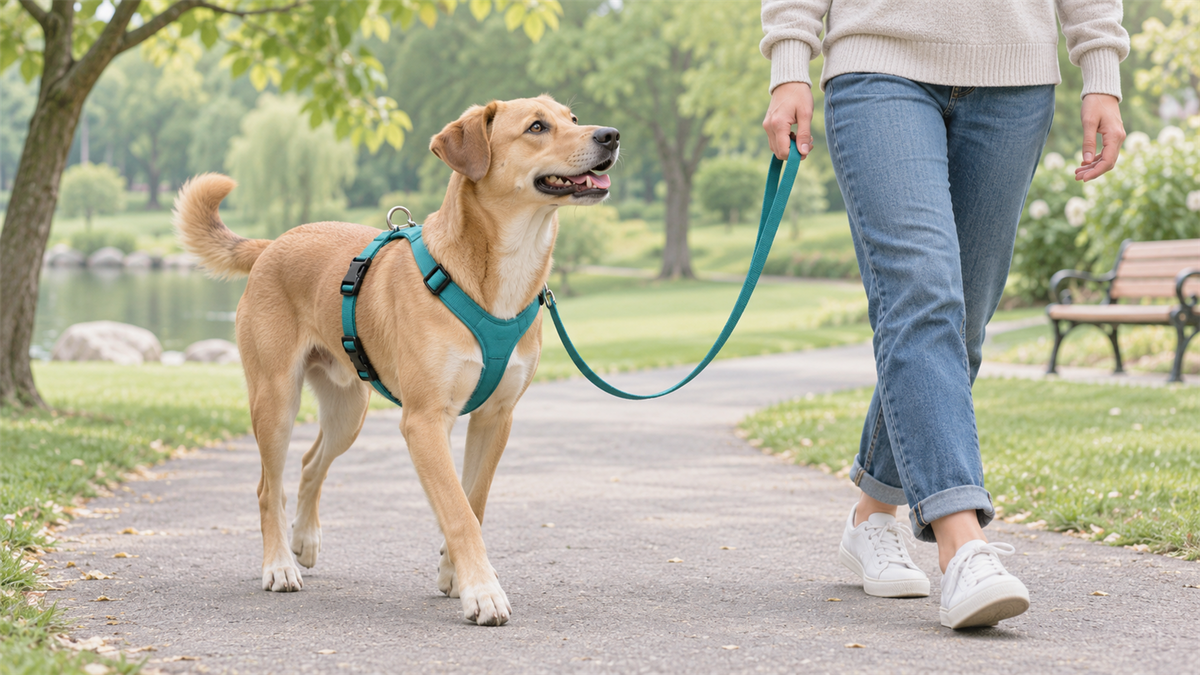
After fitting and adjustment, check your dog from the front and side.
For either style:
- Straps and panels should lie flat.
- Buckles should close fully without pinching.
- The harness should not press into the throat.
- Edges should not rub behind the front legs.
- Your dog should be able to walk, turn, sit and lie down naturally.
- The harness should not rotate excessively or leave large gaps.
For a vest, pay particular attention to the panel edges and neck opening. For a strap design, watch whether the bands shift or bunch as your dog moves.
Start with a short supervised fitting session and recheck after movement.
Which Style Should You Choose?
Consider a vest-style harness if you prefer a panel-based design and can find a model whose neck opening, chest range and coverage match your dog.
Consider a strap-style harness if you prefer less fabric coverage and can position the straps comfortably within the product’s adjustment range.
In either case, choose the individual model that fits. A well-matched design is more useful than selecting a style because it is described as universally comfortable, secure or suitable for every dog.
Frequently Asked Questions
Is a vest harness better for small dogs?
Not automatically. Small dogs still vary in chest shape, neck size and proportions. Check the product’s measurements, hardware size and fit.
Is a strap harness better for large dogs?
Size alone does not determine the best style. Consider the harness’s intended use, sizing range, construction and any supported strength specifications.
Are all vest harnesses padded?
No. Some use mesh or lightweight fabric without substantial padding. Read the material and lining details for the specific model.
Can both styles have front and back leash attachments?
Yes, but availability depends on the product. Check the instructions and photos rather than assuming attachments from the style name.
What if one size fits the chest but not the neck?
That size may not suit your dog. Check the adjustment ranges and ask for sizing help. A different harness shape may be a better option.
Compare Styles Using Your Dog’s Measurements
Browse the Eagerlive Dog Harnesses collection and compare each model’s coverage, opening method, adjustment range and designated leash attachments.
If a measurement or construction detail is unclear, contact service@eagerlive.com with the product link and your dog’s measurements before ordering.